

 If you have a musculoskeletal injury or movement dysfunction, your doctor may refer you to physical therapy to help decrease pain and improve mobility. Your symptoms may be mild, or you may have symptoms that severely limit your functional mobility.
Many treatment options exist for patients who are referred to physical therapy in a modalities program in Rowlett, Texas. Physical agents and modalities are often used to decrease pain and inflammation. Exercises may be prescribed to help improve endurance, strength, or range of motion. Your physical therapist should be prepared to explain to you the reason for each treatment and what to expect from each treatment.
Types of Modalities
Russian Stimulation
Russian stimulation is a form of electrical stimulation that uses electricity to contract muscle tissue. After injury or surgery, you may be experiencing muscle weakness. Often, muscles are inhibited after an injury and are unable to generate a forceful contraction. Russian stimulation is used to help improve the contraction of your muscles.
Neuromuscular Electrical Stimulation in Physical Therapy
Neuromuscular Electrical Stimulation (NMES) is used much like Russian stimulation. Your physical therapist may use NMES to help your muscles contract properly after injury or surgery. This form of muscular re-education can be useful in helping you return to normal function quickly after an injury or surgery.
Interferential Current (IFC)
Inferential Current (IFC) electrical stimulation is a type of electrical stimulation that your physical therapist may use to help decrease your pain and improve circulation to injured tissues. The IFC works much like TENS, but the current can be easily moved and varied to target your most painful area of injury.
High Voltage Stimulation
High voltage electrical stimulation is a type of electrical stimulation that your physical therapist may use to help decrease your pain or improve circulation. It is also occasionally used to help with wound healing.
Ultrasound
Ultrasound is a deep heating treatment used to treat many musculoskeletal conditions, such as sprains, strains, or tendonitis. Ultrasound is administered by your physical therapist using an ultrasound machine. A wand called a sound head is pressed gently against your skin and moved in small circular sweeps near the site of injury. A small amount of gel is used so the ultrasound waves are absorbed into the skin and muscles.
Traction, Also Known as Spinal Decompression
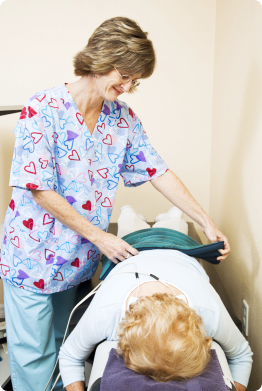
Traction is used in the treatment of low back pain and neck pain to help decrease pain and improve mobility in the spine.
To use lumbar traction, you must be strapped into a mechanical machine. There is a vest that helps support your ribs, and another device that wraps around your pelvis. The vest and pelvic device are stabilized with straps, and a mechanical force is applied with a machine.
Cervical traction is applied in either the sitting or lying position. If sitting, a harness is attached to the head, and a pulley system is used with a small weight attached. The weight provides the traction force while you sit comfortably in a chair. In lying, or supine, traction, a specific device is used. You must lie down on your back and strap your forehead to the device. Then, a pneumatic pump is used to help provide the traction force to your neck.
Theoretically, traction helps to separate the joints and disc spaces in the low back or neck, which in turn helps to decrease pressure on spinal nerves.
Cold Laser Treatment
Cold lasers are handheld devices used by the clinician and are often the size of a flashlight. The laser is placed directly over the injured area for 30 seconds to several minutes, depending on the size of the area being treated and the dose provided by the cold laser unit.
During this time, the non-thermal photons of light that are emitted from the laser pass through the skin’s layers (the dermis, epidermis, and the subcutaneous tissue or tissue fat under the skin). This light has the ability to penetrate 2 to 5 centimeters below the skin at 90mw and 830 nm.
Once the light energy passes through the layers of skin and reaches the target area, it is absorbed and interacts with the light-sensitive elements in the cell. This process can be compared to photosynthesis in plants – sunlight is absorbed by plants, which is then converted to usable energy so that the plant can grow.
When cells absorb this light energy, it initiates a series of events in the cell that is theorized to eventually result in normalizing damaged or injured tissue, a reduction in pain, inflammation, edema, and an overall reduction in healing time by increasing intracellular metabolism.
Cold Laser therapy offers a non-intrusive option to acupuncture and surgery. It also provides a non-addicting treatment that eliminates the complications of long-term drug treatment programs. Cold lasers are FDA-cleared and widely used for the treatment of:
- Acute and chronic pain
- Ligament sprains
- Muscle strain
- Soft tissue injuries
- Tendonitis
- Arthritis
- Tennis elbow
- Back pain
- Bursitis
- Carpal Tunnel Syndrome
- Fibromyalgia
Whatever your need is for a quicker and more thorough recovery, we have a variety of modalities that are right for helping you heal and return to the activities you enjoy pain-free.
Frequently Asked Questions
How does electrical stimulation help muscle recovery after injury?
How does Russian stimulation support weak muscles?
How does cervical traction differ from lumbar traction?
How does cold laser treatment support tissue healing?
What conditions are commonly treated with cold laser therapy?
Let’s Help You Move Better Again
Ready to start your recovery? Call Excel Spine and Sports Rehab PC today to schedule an assessment. You may reach us at 469-443-0458.